
Developmentally Appropriate Sleep Expectations: Birth To Age 5 by Kim Hawley
Introduction
Hi all, this week we’re excited to share a special post from Holistic Sleep Coach and IBCLC Kim Hawley. Kim teaches sleep classes and offers consultations at the intersection of sleep & lactation with The Breastfeeding Center and also runs her own practice, Intuitive Parenting DC. Have questions about your child’s sleep patterns? Kim put together a starter guide that breaks down typical sleep for each age group.
Even better—her consultations with The Breastfeeding Center and classes can be billed to our in-network insurance plans: UnitedHealthcare, Aetna, Blue Cross Blue Shield, and DC Medicaid. Book with her here for 1:1 guidance.
-
Most parents worry about their child’s sleep at some point. If you find yourself worrying if your baby’s sleep is normal or if you are doing enough to support healthy sleep patterns, you are in good company. It can be hard to know what healthy sleep patterns even are on a topic so filled with cultural bias and opinions rather than evidence-based information. Our culture perpetuates a lot of unrealistic expectations around sleep. When we strive to meet unrealistic expectations, we often feel stress, guilt, and even failure when we ultimately can’t. Understanding normal sleep at different ages can free you to work with your child’s needs rather than struggle to shape their sleep into something developmentally inappropriate.
Below is an outline of realistic expectations for your child’s sleep in the first 5 years. I first wrote this guide in 2018, and I’m revisiting it again to improve and update the information. I hope you find it helpful!
This is a guide, not a goal. Remember the best way to tell if your baby or toddler is getting enough sleep is to look at them. Their behavior and general mood are good places to start. There is a wide range of normal, and your child will help you know the right amount of sleep for them.
Relevant Context
***Skip Ahead If You Are Too Tired For This Part!***
It’s important to know where we have high quality evidence, and where we don’t. While we have a good evidence-base on total sleep in 24 hours, evidence is less strong or completely lacking on other measures including awake windows, ideal nap length, or even the concept of sleep regressions. I’ve listed common ranges for awake windows and ages where sleep can get disrupted, but take them as an experience-based guide, not hard science. Only use them if they decrease your stress, not add to it!
The age when your baby/toddler/preschooler begins routinely sleeping for long stretches without need for you varies greatly. The nighttime sleep ranges provided consider some night waking for feeding and soothing.
Temperament and household patterns will also affect your child’s sleep patterns. Some babies need much more sleep than others, nap more or less than average, go to bed early/later than is typical, and need more or less parental support at night. Your family’s daily patterns, sibling sleep patterns, and cultural practices can affect your child’s sleep patterns. Some wiggle room on either side of these typical sleep numbers may be fine for your little one, and in fact the National Sleep Foundation (NSF) specifically recognizes a “may be appropriate” category which broadens their recommended sleep ranges by several hours. If your little one seems to be doing well, it’s not something to stress about. If your child’s sleep patterns are problematic for your family, however, sleep totals outside of what’s expected may be a helpful piece of the puzzle.
Again, I’d like to stress there is a wide range of normal. Watch your little one and use numbers as a rough guide.

K
Age Appropriate Sleep Expectations Overview
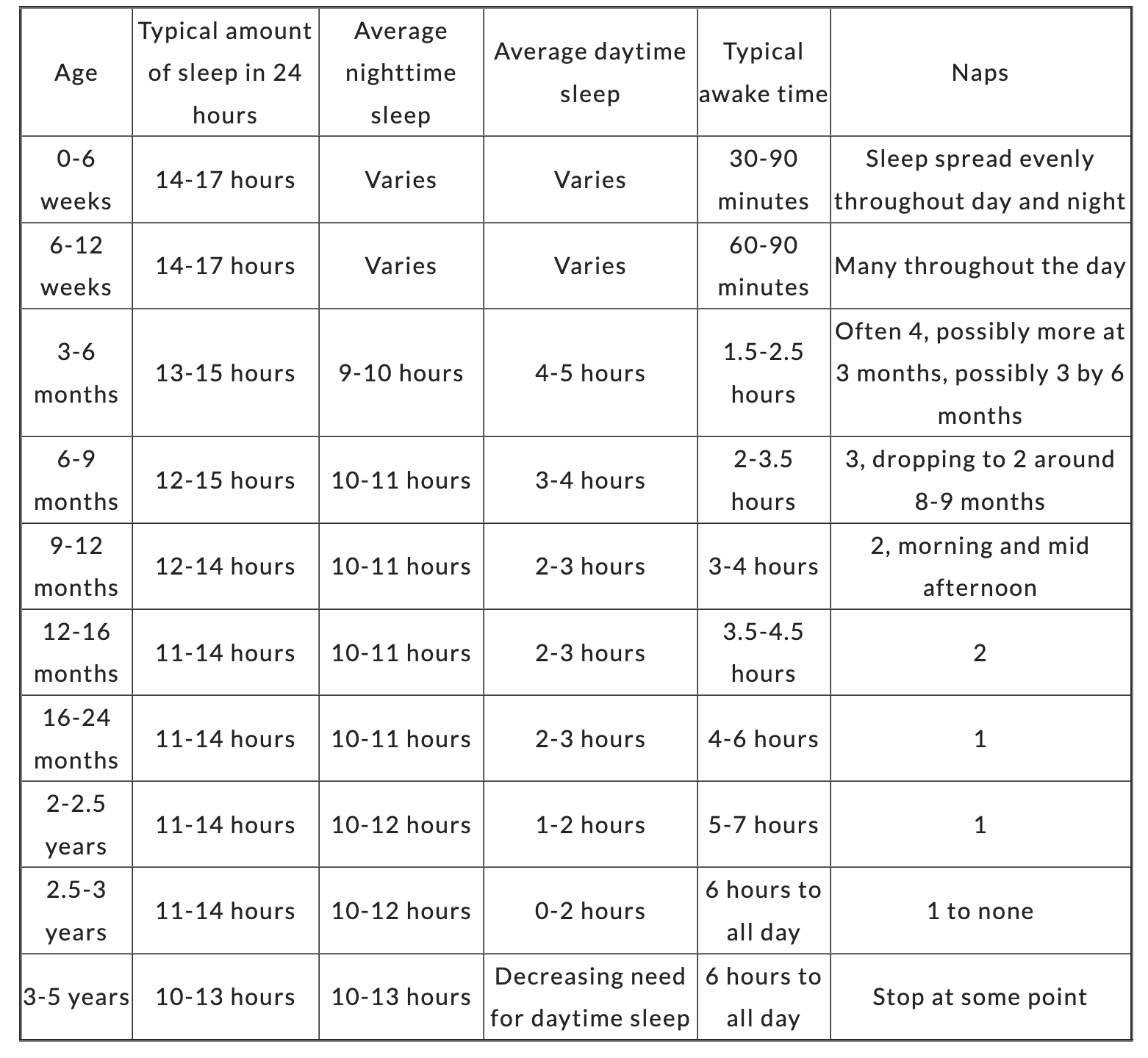
For access to the full guide, and to learn more about developmentally normal sleep by age, head over to read the full blog post.
Kim Hawley MA, MPH, IBCLC, Sleep Consultant

Kim is a Holistic Sleep Coach, Lactation Consultant, and Peaceful Parenting Educator. She helps tired parents combine developmental knowledge with their intuition to improve family sleep. Her specialty is holistic, responsive sleep support for babies, toddlers, and nursing families. She loves helping parents understand normal baby and toddler sleep, while providing connection-focused tools and strategies to gently optimize and change things when they are no longer working for a family. Kim Lives in Capitol Hill with her husband and 2 kids. She loves running, listening to audiobooks, coffee, and chocolate!